

Lease preparation
Streamline your lease preparation
%3bfill-opacity:.38'/%3e%3cpath fill-rule='evenodd' clip-rule='evenodd' d='M29.255 13.678H15.986c-.977 0-1.77.709-1.77 1.583v11.221H25.88c.85 0 1.433.713 1.421 1.423-.008.568.073 1.223.378 1.71.148.236.346.428.613.56.105.05.224.095.361.128h.602c.977 0 1.77-.71 1.77-1.584V15.261c0-.874-.793-1.583-1.77-1.583Zm-2.144 16.625a2.468 2.468 0 0 1-.195-.27c-.429-.684-.509-1.523-.5-2.14.006-.335-.268-.585-.536-.585H14.217v1.411c0 .875.792 1.584 1.769 1.584h11.125Z' fill='%23009EFF' style='fill:color(display-p3 0 .6196 1)%3bfill-opacity:1'/%3e%3crect x='17.755' y='20.011' width='9.731' height='.792' rx='.396' fill='white' style='fill:white%3bfill-opacity:1'/%3e%3crect x='20.409' y='16.844' width='7.077' height='.792' rx='.396' fill='white' style='fill:white%3bfill-opacity:1'/%3e%3crect x='21.294' y='23.178' width='6.192' height='.792' rx='.396' fill='white' style='fill:white%3bfill-opacity:1'/%3e%3crect x='17.755' y='23.178' width='2.654' height='.792' rx='.396' fill='white' style='fill:white%3bfill-opacity:1'/%3e%3cpath fill-rule='evenodd' clip-rule='evenodd' d='M15.693 30.854c-2.684 0-3.833-1.863-4.29-3.032-.186-.476.215-.927.757-.927h13.72c.558 0 .987.482.979 1.004-.019 1.186.323 2.987 2.592 2.878-4.644.162-9.843.076-13.758.076Z' fill='%23009EFF' style='fill:color(display-p3 0 .6196 1)%3bfill-opacity:1'/%3e%3c/svg%3e)
Tenancy management
For a good tenant relationship

Lease termination
End leases legally and smoothly

' fill='%23E9F0FA'/%3e%3crect opacity='.39' width='228.538' height='284.447' rx='10' transform='matrix(-.96315 -.26897 -.26927 .96306 314.707 85.06)' fill='%23E9F0FA'/%3e%3cg filter='url(%23a)'%3e%3crect x='20.234' y='16' width='228.877' height='284.494' rx='10' fill='url(%23b)'/%3e%3c/g%3e%3crect x='55.996' y='138.918' width='154.492' height='3' rx='1.5' fill='%23E9F0FA'/%3e%3crect x='55.996' y='168.918' width='154.492' height='3' rx='1.5' fill='%23E9F0FA'/%3e%3crect x='55.996' y='198.918' width='154.492' height='3' rx='1.5' fill='%23E9F0FA'/%3e%3crect x='91' y='239' width='88' height='3' rx='1.5' fill='%23E9F0FA'/%3e%3cdefs%3e%3clinearGradient id='b' x1='388.584' y1='650.035' x2='42.732' y2='7.248' gradientUnits='userSpaceOnUse'%3e%3cstop stop-color='%23F7FAFF'/%3e%3cstop offset='1' stop-color='white'/%3e%3c/linearGradient%3e%3cfilter id='a' x='.234' y='0' width='268.879' height='324.494' filterUnits='userSpaceOnUse' color-interpolation-filters='sRGB'%3e%3cfeFlood flood-opacity='0' result='BackgroundImageFix'/%3e%3cfeColorMatrix in='SourceAlpha' values='0 0 0 0 0 0 0 0 0 0 0 0 0 0 0 0 0 0 127 0' result='hardAlpha'/%3e%3cfeOffset dy='4'/%3e%3cfeGaussianBlur stdDeviation='10'/%3e%3cfeColorMatrix values='0 0 0 0 0.827604 0 0 0 0 0.876287 0 0 0 0 0.945833 0 0 0 0.47 0'/%3e%3cfeBlend in2='BackgroundImageFix' result='effect1_dropShadow_8355_25104'/%3e%3cfeBlend in='SourceGraphic' in2='effect1_dropShadow_8355_25104' result='shape'/%3e%3c/filter%3e%3c/defs%3e%3c/svg%3e)
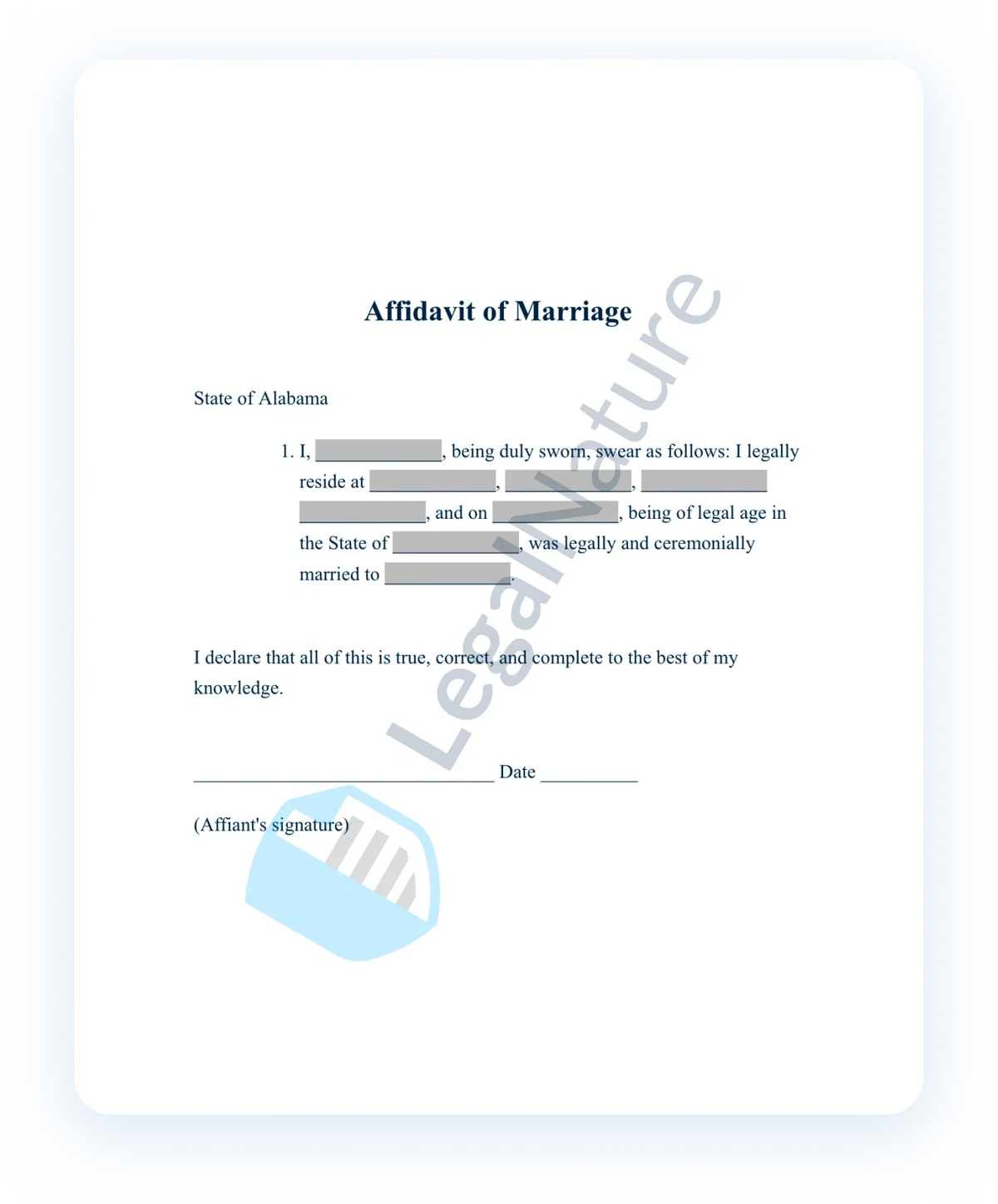
An affidavit of marriage is a sworn legal document in which one or more people testify under oath about the existence and validity of a marriage. This document is typically used when a couple needs to prove their marital status but lacks traditional documentation like a marriage certificate (common situations include lost or destroyed certificates, marriages performed in foreign countries, or marriages that occurred many years ago without proper registration). The affidavit is signed before a notary public or other authorized official and includes details such as the spouses' names, the date and location of the marriage, and the relationship of the person making the statement (affiant) to the couple.
Need another type of affidavit? Choose one below:
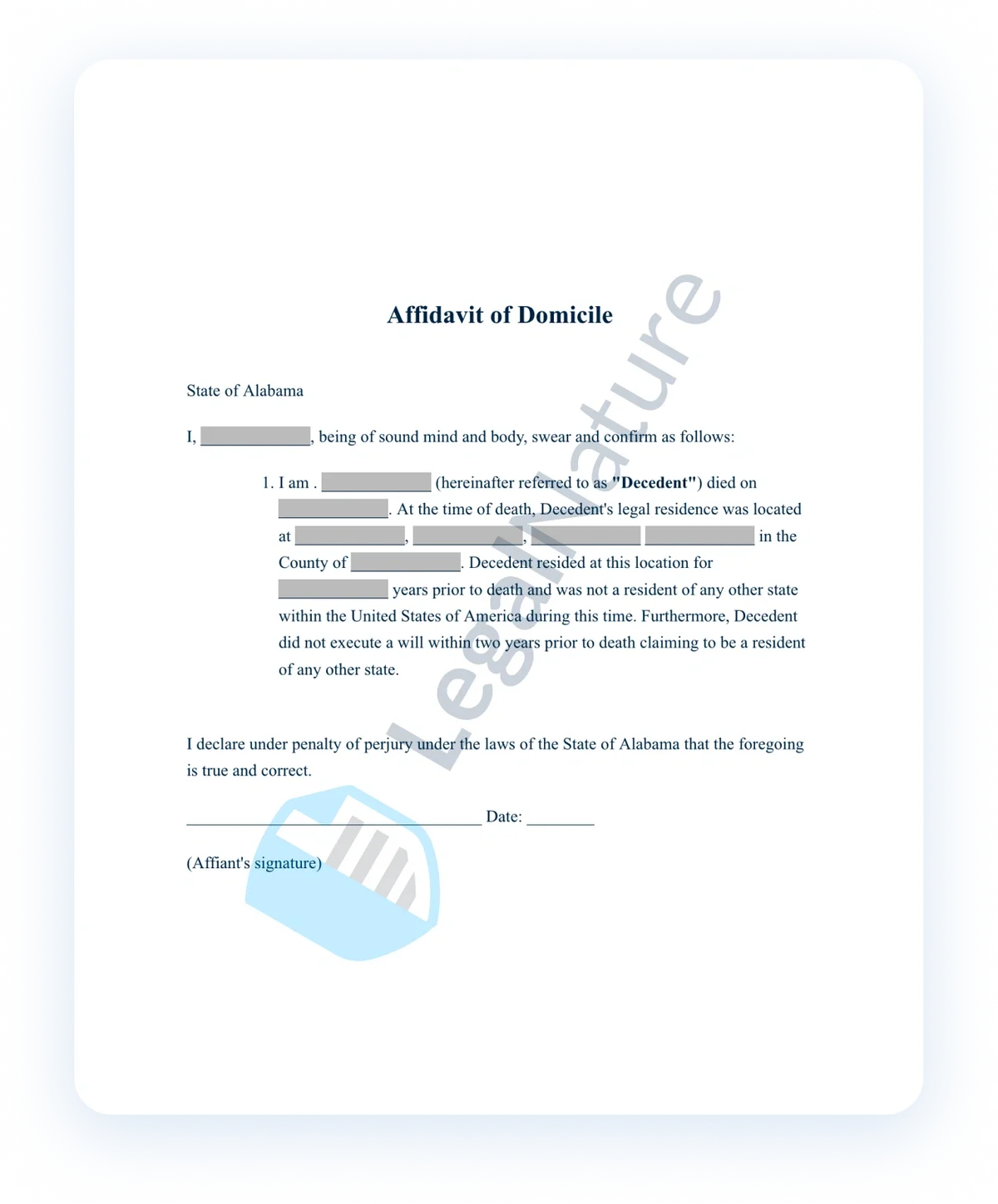
Affidavit of Domicile An affidavit of domicile is a sworn statement that declares where a deceased person had their permanent legal residence at the time of death. It is used to verify where the deceased person lived during their lifetime and may be required by financial institutions to transfer stocks or other securities, close accounts, or settle estate matters.
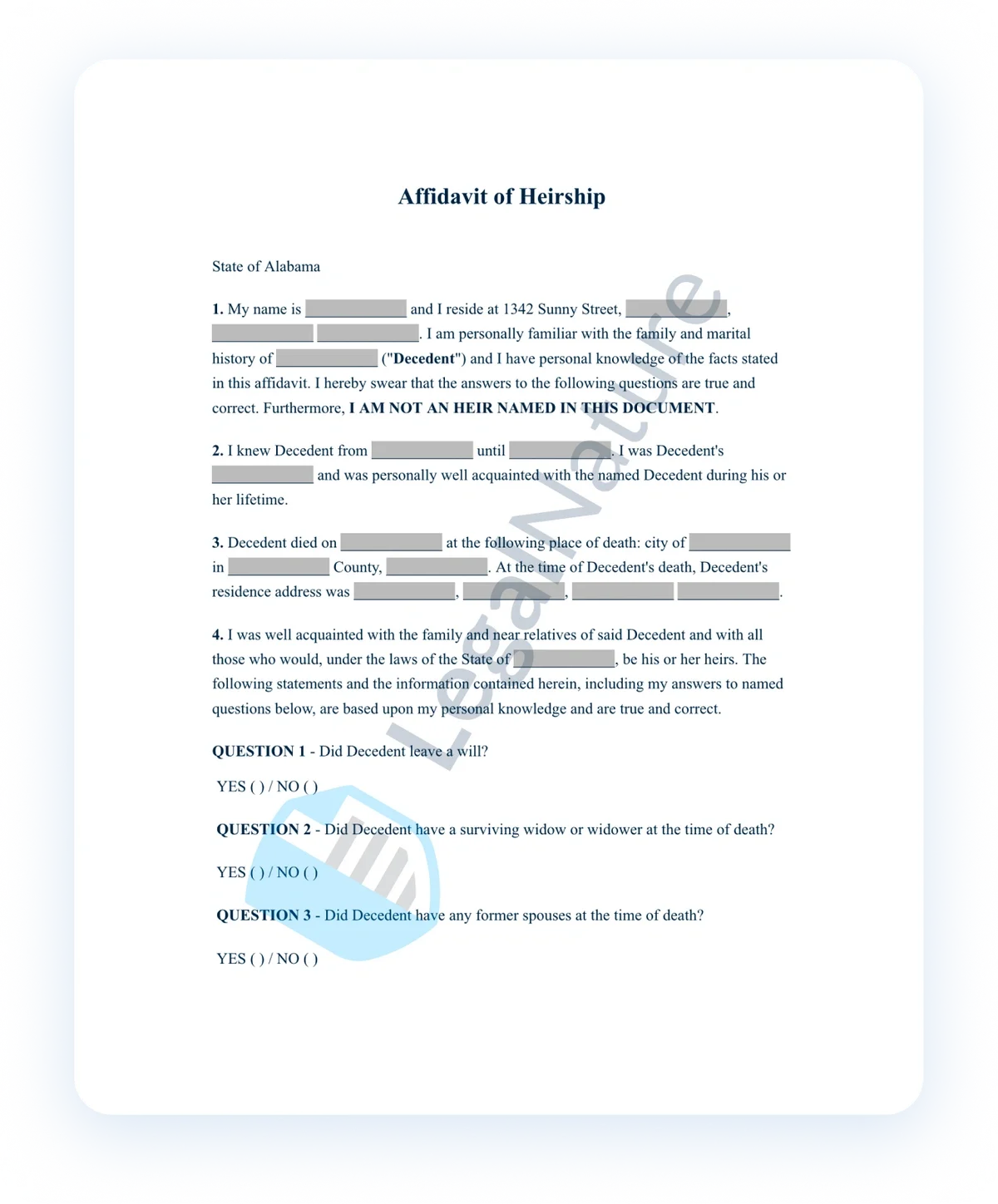
Affidavit of Heirship An affidavit of heirship is a legal document filed in court by the beneficiaries of an estate to help transfer the deceased person's real estate or personal property.
Create an affidavit of marriage in your state
- Alabama
- Alaska
- Arizona
- Arkansas
- California
- Colorado
- Connecticut
- Delaware
- District of Columbia
- Florida
- Georgia
- Hawaii
- Idaho
- Illinois
- Indiana
- Iowa
- Kansas
- Kentucky
- Louisiana
- Maine
- Maryland
- Massachusetts
- Michigan
- Minnesota
- Mississippi
- Missouri
- Montana
- Nebraska
- Nevada
- New Hampshire
- New Jersey
- New Mexico
- New York
- North Carolina
- North Dakota
- Ohio
- Oklahoma
- Oregon
- Pennsylvania
- Rhode Island
- South Carolina
- South Dakota
- Tennessee
- Texas
- Utah
- Vermont
- Virginia
- Washington
- West Virginia
- Wisconsin
- Wyoming
When to use an affidavit of marriage
An affidavit of marriage should be used in specific situations where formal proof of marriage is required but the original marriage certificate is unavailable, insufficient, or needs corroboration. The most common scenarios include the following:
- When official documentation is missing or inadequate: This includes cases where the marriage certificate has been lost, destroyed, or damaged beyond use; when the marriage occurred in a foreign country and the certificate needs translation or additional validation for U.S. purposes; when marriages were performed decades ago and records were never properly filed or have been lost by the issuing authority; or when informal or common law marriages need legal recognition and documentation.
- For immigration purposes: Affidavits of marriage are frequently required in immigration proceedings, particularly for spousal visa applications (K-1, CR-1, IR-1) where USCIS may request additional evidence beyond the marriage certificate to establish the bona fide nature of the relationship.
- Acquiring government benefits: Marriage affidavits may be used when applying for Social Security survivor benefits, veterans' spousal benefits, or other government programs that require proof of marital status.
- Estate and probate matters: Affidavits of marriage may be needed for estate and probate matters when a surviving spouse must establish their legal relationship to claim inheritance rights or handle the deceased spouse's affairs, for insurance claims where beneficiaries need to prove spousal status, for property transactions involving jointly owned real estate, or when updating legal documents like deeds or titles to reflect marital status. In these situations, the affidavit typically comes from third-party witnesses (friends, family members, clergy who performed the ceremony) or from the spouses themselves, sworn under penalty of perjury and notarized to provide legal weight to the testimony.
Create your affidavit of marriage in 3 easy steps
Collect Information
Gather all the relevant information to complete your document. This may include the date, time, and location of the marriage.
Answer Key Questions
Use the information you collected to complete our affidavit of marriage form. We make this easy by guiding you at each step of the way and helping you to customize your document to match your specific needs.
Review, Sign, and Notarize
It is always important to read your document thoroughly to ensure it matches your needs and is free of errors and omissions. You must sign the affidavit in front of a notary public. When using a notary, always be sure to wait to sign the document until he or she is present.
Why use an affidavit of marriage?
The key reasons to use an affidavit of marriage include establishing legal proof when certificates are unavailable (lost, destroyed, never issued, or from jurisdictions with poor record-keeping); corroborating marital status for immigration purposes where USCIS requires evidence beyond the certificate itself to prove the marriage is genuine rather than fraudulent; providing third-party verification through witness testimony from family, friends, or officiants who can attest to the ceremony and ongoing marital relationship; meeting specific agency requirements where organizations like insurance companies, Social Security Administration, or probate courts request sworn affidavits as part of their documentation standards; and bridging documentation gaps for common law marriages, foreign marriages, or historical marriages that lack conventional paper trails. Essentially, the affidavit transforms personal knowledge about a marriage into a formal legal document that can be accepted by courts, government agencies, and other institutions that require verified proof of marital status under penalty of law.

Why choose LegalNature?
The professionals at LegalNature offer the expertise and guidance to navigate the nuances of creating an affidavit across all 50 states and the District of Columbia. LegalNature offers a 30-day money-back guarantee. If you're not happy, then we’re not happy. Give us a call and let us help.
Affidavit of marriage help guide
Your affidavit of marriage will act as your sworn statement that you were validly married on the date and at the location specified. Whenever both spouses are available, we recommend that they both include their information and sign the affidavit.
To complete the affidavit, enter the current full legal name or names of the spouses involved. When entering in the addresses, be sure to use the address where the spouse currently lives.
The most important pieces of information are the date and place of marriage. Try to be as accurate as possible when entering in these items. The place of marriage is wherever the spouses signed the original certificate of marriage. In most states, there would have had to be some type of officiate at the ceremony, such as a priest or judge.
The final step is to sign the document in the presence of a notary public. If both spouses are signing, they must both sign it in the notary's presence or have it separately notarized. After that, your affidavit is complete.
Create your affidavit of marriage in minutes
Complete our form
Preview and download your document
Review and sign your document